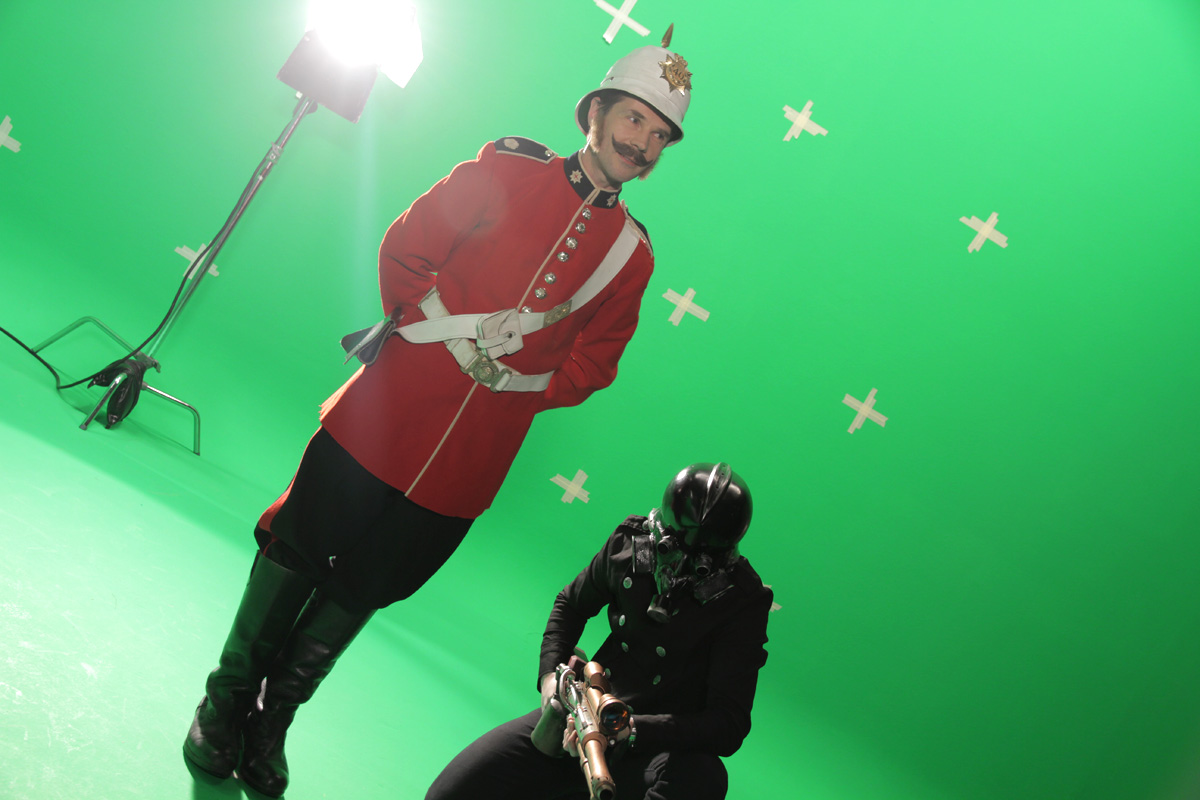
Plotting a Murder

Posted Sunday, May 12, 2013, 4:29 PM


I really like the new Channel TEN comedy/drama series Mr and Mrs Murder. I like the premise, of the crime scene clean-up crew noticing clues that were missed by the Police and figuring out who the killer was. I like the characters, a married couple (Shaun Micallef and Kat Stewart as Charlie and Nicola Buchanan) who adore each other and have fun and silly conversations, and who drag their niece (Jess, played by Lucy Honigman) in to their schemes as their unwitting accomplice. I like the distinctive environments where each murder takes place.

But there is much that I don't like, and those things kind of ruin it for me. So much potential to be a really good original show, that would even work internationally, but they mess it up in too many places.

The biggest problem for me is that there's no sense of jeopardy. When you have two people who are overstepping their bounds in a criminal investigation, there really ought to be consequences. Admittedly the Detective, who has a soft spot for Nicola, and recognises their abilities as amateur sleuths, gives them free rein, carte blanche, all-access pass, but the suspects ought to be somewhat less forthcoming with spilling their guts to strangers who have no right to be where they are, doing what they're doing, questioning who they're talking to. There have been a couple of cursory scenes in two or three episodes where they've been lightly confronted, but they still get the answers they seek too easily.

The murderer has to be engineering it so that they cannot be fingered as the culprit; constructing lies, alibis, and misdirection that puts the Police off their scent, but such that an outsider with a fresh point of view would not be distracted and can see through their web of deceit. Instead we are presented with four suspects, and they just go about their business like nothing happened. They don't seem affected by the murder, don't seem to be afraid for their own lives when there's a killer on the loose, don't seem to be actively trying to deflect the investigation that would reveal their guilt, and instead are just sitting around under the bold assumption that nobody is going to ask them any questions.


Now what the hell are the Police doing while this is going on? They wander around in the background of the crime scene at the very start of each episode, if you're lucky, and they seem to be there to arrest the guilty party at the very end, but apart from that they seem to be completely absent, coming across as lazy, incompetent boobs who aren't doing any groundwork that real investigators do. They need to have some kind of interaction with Charlie and Nicola, an opportunity for them to pick up new clues, overhear conversations, swap information, just enough for it to look like the Police are actually doing some work. Having the Detective, Peter, occasionally appear to moon over Nicola and then tell them lists of stuff isn't enough, it's too cheap and easy an exposition tactic, and feels clumsy at best.

The pacing is all wrong. This is not the fault of the writing, I don't think, which is generally pretty decent, especially the dialogue. Instead I think it's something that can easily be fixed in Post Production, in the editing and the music. When you're dealing with a drama like this, there needs to be stakes. You have to feel that if the murderer isn't found they may strike again, they may even attack the investigators who are getting too close to the truth. The audience has to feel like there may be danger at any turn. You can do this with careful editing, that increases the urgency, builds up tension, shows facts that cause the audience to fear for the protagonists' lives as they go about their amateur investigating. Editing shots faster, lots of close ups not showing faces, shadows and footsteps, a sense of close pursuit, music that builds tension to a climax where they finally discover, and then directly confront, the murderer. Then a short denouement where they tie up the loose ends, explain some of the plot twists, and relax after a job well done.

Too often the pacing was on an even boring keel. No sense of adventure, excitement, or risk. No confrontation. Too often a line of dialogue was something like "I think I know who did it!" and then they cut to a shot of the bad guy being carted away in cuffs. No confronation, no demand for an explanation, no confession. Pathetic.


On an unrelated but equally annoying note, the opening titles really bother me. I like what they're going for, comic book style graphics, with nice plinky-plunk detective type music, but the images don't match to the rhythm of the music, and it really annoys me. All they needed was for title text and comic book frames to appear on the beats, for the animation of the images to be in actual perspective instead of randomly sliding around, and with a sense of storytelling (and maybe if the likenesses of the characters were slightly more accurate) I would be giving them high praise, but what they've actually got is just frustratingly inept and poorly directed.

Now I'm not an especially good writer, and have no real professional experience. And to be perfectly honest I don't think it's the writing that is at fault, it's clever, original, funny, and is expertly performed by the cast, so I can't blame that at all. I think it's a flaw in the directing of the pre- and post-production, establishing how the story should be played out, and how to achieve the best end result with what you've got in the can.

If there's a second series, I hope they pay attention to these factors. They're small, in the grand scheme of things, and easily addressable. And if they're looking for script doctors to help them out, I'm available.

####

EDITED TO ADD:
And then the final episode of the season plays and it addresses almost all of my concerns, including pretty much everything I was after: Jeopardy for the main characters, Police involvement, ramping up the exciting pace to a climactic conclusion, and a satisfying denouement. Brilliant stuff! If there's a second series, just do more like that, please.

When I Have An Idea, I Stick To It

Posted Wednesday, April 24, 2013, 10:36 PM


There's a risk when you get onto your film set, that you adhere too closely to the ideas you have had churning in your head for so long. Once you've decided that you want, for example, a shot of the actor's feet, a pan up to their waist where they are holding an object, and then up to their head where they have a steely glint in their eye before they exit out of shot, you are determined that you will get that shot by hook or by crook. So you build a rig for your camera that can make the move, you position your actor in just the right angle, you wait for the sunlight to be perfect, your camera operator practices the shot over and over, until finally you film it... and it ends up looking a bit wobbly, out of focus, and you can't even see who it is and what's going on. The shot you thought was going to be so cool turns out to be crap, a waste of time that never makes the final cut.

You have to go onto set with alternative plans, an open mind, be prepared to change everything at the drop of a hat. An idea, perhaps suggested by the location, the time of day, or a whim that your first assistant makes up on the spot, could mean your entire morning is rearranged to accommodate for it. If it's a better idea, then be ready to drop everything and go for it.

A few days before going on set for my Steampunk short film, Eleanor Xandler: Temporal Detective, I drew up some storyboards of about half the shots I had planned. Each one also was intended to have a close up and a wide, and additional shots from the 'B' camera, but broadly the plan was for them to stay the same angle with the same action as I had boarded.

Here are some of the completed shots alongside their storyboard. It just goes to show, when I have a good idea, I stick to it.


Layer Upon Layer Upon Layer

Posted Sunday, January 13, 2013, 12:10 PM


I first saw Photoshop when it came free on a coverdisc on a magazine and my friend Dion installed it on his PC, back in the early 90s. He thought that I, as an artist, would find it useful to create some of the artwork required for our little projects. But after opening it up I was mightily confused. This was probably version 2.0, and it did not come with a manual (before the Internet, before PDFs, physical books were the only way manuals were provided). I was completely lost by the multitude of buttons, tools, menus, and icons. Where do I even begin? So for the first couple of times I scribbled colourful swirls and then just sat there. I couldn't figure out how to do straight lines, the mouse had no easy way to draw like a pen, and so clumsily I moved the pointer around a few times, achieving nothing.

It was about five years before I opened up Photoshop again. I had just been hired as a website designer for the first time, and I was completely new to the specifics of that job. I was hired solely on my artistic abilities and my familiarity with computers, but had no specific experience with HTML or Photoshop graphics. So I was allowed about two months just to familiarise myself with both those things.

Now I had a purpose for using Photoshop. I was given a Wacom drawing tablet, and with a goal in mind could go through all the steps to achieve an image. How do I create a box with round corners and highlighted edges? How do I create a drop shadow, a gradient, or coloured text? This was version 4.0 of Photoshop, so certain things did not exist yet - no multiple Undo, no auto dropshadow and glow (known as Layer Styles), no Batch Actions. But I had a manual, I had a few excellent quality guide books, and a mailing list of Professionals including some Adobe employees, all of whom were really helpful.

And the key to using Photoshop effectively is understanding layers. Unlike drawing or painting, where you're stuck with a single sheet of canvas or paper to just pile stuff on top of itself, with Photoshop you have individual layers which you can move, erase, recolour, distort, fade transparency; an infinite amount of adjustment, for each individual small part that you choose. It's a fantastic way to create.

Over the years I've learned a lot more about Photoshop, that there are multiple ways to achieve the same thing, that each subsequent version adds features that make some jobs a lot easier, it integrates better with Adobe's sister-products, and evolves and adapts to be useful for new technologies.

And one day I had to learn to use another of Adobe's products, called After Effects. When I first used it, I didn't understand just how powerful it could be. It seemed like a fewer-featured Photoshop. But in fact its role, to composite different video elements together for Visual Effects, requires such specific tools that comparing it with Photoshop is futile. After Effects is its own thing, and arguably even more powerful.

But one similarity, that it uses even more effectively than Photoshop, is its use of Layers.


I am slowly working my way through each shot for my Steampunk short film, "Eleanor Xandler: Temporal Detective," mostly in chronological order, and have just completed one of the most complicated shots of them all. And that's because it's a shot I didn't actually film on the shoot day. I realised, after looking at the rough edit, that there were a couple of shots that I really needed in order to transition from one shot to another effectively, and I had not thought ahead enough to have filmed those shots, so I wondered if I could make them up using what I could find amongst the clips I had.

One particular shot was from after I had called "Cut!" and the actress playing Eleanor, Sarah Breen, looked over to me to check if I was happy. That glance was all I needed to convey what was required, so I had now found my missing shot. Simple. But there was another shot I needed that was vastly more epic, and luckily this is where shooting on greenscreen, and having plenty of Behind-The-Scenes photography, each come in handy.

I wanted an Establishing Shot, one that shows the audience the location where the scene takes place, and orients them to where the characters are standing in relation to each other. I hadn't thought to film such a shot, because in my head I knew where everyone was. But that's not good enough, because of course I know, it's my story. I know plenty of things that the audience do not, it's my job to make sure all of those things are conveyed where necessary, be it through dialogue, performances, or editing. So now I had to create a shot that told everyone where my two characters were actually standing.

And where they're standing is in a huge dark smoky warehouse, filled with junk and decorated by 1880s style structural architecture. I had to create an over-the-shoulder shot of Eleanor entering through large doors, pointing her weapon at the Professor who was at the far end of the building, all while showing off how large and beautiful the warehouse was.

The warehouse 3D model had already been built, as an exterior and in preparation for all the interior shots that I was going to composite, but only in a limited fashion. Only build what you need, as anything more is just going to slow down the process. Well, now I had to expand on that, as this additional unplanned angle meant more of the warehouse would now be seen. I added in extra features, including a spiral staircase, an extra wall, a couple of piles of junk, and additional detail on the interior skylight roof.

During the shoot I had a B Camera, which is a second camera recording the shots from different angles and framing, giving me extra footage I can cut to should I need it. One of those shots was almost an over-the-shoulder of Eleanor, except from the wrong side, and that section of it was only 30 frames long. I needed 100 frames at least, but I clipped the shot out, flipped it to match the angle, and then stretched and reversed the shot a couple of times to extend its length. This can sometimes be glaringly obvious, I've seen reversed shots in feature films before and there's a few physics giveaways that you can spot sometimes (a turn or a blink in reverse looks slightly peculiar) so in order to hide the trick I made sure the part of the shot that was Eleanor would be completely out of focus with the depth of field.

In the far distance is the Professor. None of the shots I had of the Professor were full length, they all cut off at his knees or higher. Extremely luckily there was a single photo taken amongst the Behind-The-Scene images which included the Professor's legs, so I grabbed that, flipped and scaled them to match, and then animated them to match his movement, which wasn't much but still had to be done.

Unfortunately the angle of the Professor shot didn't match the perspective I needed, which was most obvious with the Console Panel he was standing at. So I had to replace the console with another BTS photo, which meant I had to cut around the Professor's arm (a technique called Rotoscoping) so that it looked like he was manipulating the controls accurately. The side of the console prop also has no surfacing, so I had to fill in that blank as well.

The warehouse is full of smoke, steam, and dust, because this is Steampunk and that's what the goggles are for, so I had to layer in not just multiple instances of atmosphere, just like if there had been a smoke machine on set, but I also had to include the shafts of sunlight that came through the door and skylight.

Couple all that stuff with the camera move, which is a pan down from skylight to Professor, that I had to track and match, it makes for a very complicated shot that should, in viewing it, go by quickly and seamlessly, and convey exactly what I wanted, that the space of the building is so big, and this where the characters are standing.

Evolution of an Airship

Posted Friday, October 26, 2012, 11:20 AM

When I decided to make my first short film, Eleanor Xandler: Temporal Detective, I knew immediately I would have to film the entire thing on greenscreen. I wanted to have real locations, but that was just so difficult and complicated to achieve as they had to be so specific in their look, and there was at least one part of the story that had to be on greenscreen anyway, that it made sense to just shoot everything in one place and fill in the backgrounds later.

There are flaws with this approach. When it's been done before in the past it has had a spotty success, and this is from professionals who really know what they're doing. Films like Sky Captain, the Star Wars prequels, Lord of the Rings, and King Kong, all have at least some greenscreen in every single shot, and a few environments that are entirely digital from top to bottom - and yet, to me, it's somehow glaringly obvious. Something about the compositing, the lighting, the staging, the artificiality, I'm not sure what, gives it away, at least to me. Even Avatar was convincing only a few times.

This gives me hope. My compositing skills are not ever going to be at professional level quality, but as, apparently, that can be a bit dodgy at the best of times I am in good company.

The first artificial background I have begun creating is for the opening sequence. I figure chronological order is as good a place to start as any. This means a cloud-filled sky, and a Steampunk Airship called The Wandering Star.

My first image is crude and simplistic. That's because I quickly slapped this model together in less than an hour, as a guide to show the cast and crew what we were filming. It oriented them somewhat, and gave them something to imagine was surrounding them as they stood in an endless sea of green.

After filming was complete I began to model the final version, carefully going through it step by step to include as much detail as I could. My normal approach to 3D modelling is to be a bit slapdash, to save time, cutting corners where things won't be seen, trying to find short-cuts to achieve the look I'm after. But this time I couldn't afford to be so cheap with my attention, and tried to give the model all the detail it needed, even if it meant hours of just pushing points around in a mundanely dull fashion.

The above image is a good start, but notice on the image below that there is an adjustment between the two. The windows are bigger, the railing is thicker and closer spaced. That's because I realised the scale was wrong.

I imagined the Wandering Star as a two-person vessel, that being Eleanor and her robot pilot Gadzooks. Therefore space to move could be minimal. She's not going to be playing Shuffleboard on the Lido Deck, after all, but she might have a passenger. I adjusted the scaling to a more logical size, from 25m down to 16m long. This is not only more realistic a scale, it also means she doesn't get too tiny in the shot when the framing shows the full profile of the airship.

I then added in the water tanks. Being steampunk, there needs to be steam. That means a lot of coppery brassy tanks and pipes and whatnot, so I put in the engines that drive the propellers. I also bought a plugin for Lightwave, a handy automatic rope generator that allows me to concentrate on the placement of the rope in a simple string, and it automatically fills in the twisty detail. The ropes do make the model polygon-heavy, which causes a bit of a slowdown, but it's well worth it. They add a level of realism that brings it to life, especially when twisted around the block-and-tackle.

Texturing is a complicated procedure, something I've never been very good at. You have to adjust so many factors to get things looking right that it gets bogged down in maths and angles and trickery that I frankly struggle under the weight of. Colour, diffusion, specularity, reflectivity, occlusion, transparency...

The brass and deck textures are relatively straight forward. Brass wraps around everything evenly, so it just has to be a golden metallic colour applied on all things I have deemed should be brassy. The deck is flat, and can have the texture projected directly from above. But the rest of the objects all have UV maps.

UV maps are when you unwrap an object, especially one with an unusual shape, so that it lays flat within a square page. That way you can apply the texture as a 2D image and it will apply itself to each individual polygon consistently. If you then subsequently move, rotate, or scale the object the texture remains fixed where you want it. But unwrapping each object into its UV shape is fiddly work. The weird shape of the airship's hull means I have to wrap a wooden plank texture that follows the curvature logically, with no distortion or irregularity. Laboriously adjusting the UV point by point is the only way to achieve that.

As I continued to apply the textures one by one I adjusted the model to fit. I'd suddenly have an idea of what should be wood, what brass, to give it that industrial elegance that steampunk requires. The rudder, for example, I was looking at in its plain wooden state and just thought it looked boring. So I added a brass strip and some bolts. Then another. Then some hinged joints. And some cog gearwheels. Suddenly it looked like it actually operated in a mechanical way, something quite elaborate yet logical. I am now tempted to adjust some of the other parts of the ship to match...

This is the final model of the ship, from the angle it will be seen most often, and in profile as it will rarely be seen at all.

Someone pointed out to me that the placement of the balloon causes an apparent imbalance that would make the rear of the ship topple backwards. But hey, it's science fiction. Technically the balloon isn't big enough to lift the vessel at all. I moved the balloon that far forward to give a sense of speed and dynamism to the design of the ship, though most of the time you won't see the ship from that side and it won't look quite so awkward in motion. But if it makes you feel any better, imagine there's a heavy counterweight in the forward hold.

More Punk, Less Steam

Posted Tuesday, September 4, 2012, 9:56 PM


It was a long time coming. I have helped out on other films for the last twenty years, off and on, in both small and large capacities. An aborted attempt at helming my own a few years ago discouraged me a bit, but at long last I finally committed to an idea that really spoke to me as being a decent bit of fun, and last weekend I went ahead and directed my very first film shoot.

Leading up to the shoot day I was not at all nervous, and that surprised me. I was concerned that I'd forget something, and I wasn't entirely confident that people would listen to me and do what I ask of them, but it turned out those worries only led me to take extra care and do things right. By knowing my film sideways and backwards I had a clear picture of what I wanted, which meant I could answer questions with precision, and present myself as confident and focused. That seemed to cause everyone to respond, and led to a fast shoot, a fun day, and a creative atmosphere.


It did help that most of the crew were already friends of mine who trusted me, but there were a couple of other things that really helped me along. The costume design by Alex Chambers of Clockwork Butterfly was exquisite, and the props built by Adam Gill were perfect. That combination, when seen on my actors Sarah Breen and Phil Zachariah, as they recited their lines in the first takes, brought my vision to life, and everybody on set could see now what I was trying to create. It proved to them, and more importantly to myself, that I could do this.

I was on my feet all day. Every time I sat down, not two minutes later I was called away to something new. I had to prepare a few shots ahead at every step, I had to make sure all my crew were doing what they needed to do, knew what they needed to know, and were as busy as they needed to be, to keep them alert, interested, and informed. And it seemed to work.

I had a lot of fun, and it was strangely compelling to be in charge, something I've never felt comfortable with in the past. I think in my heart I am a co-Director, and would also love to be a co-Writer, but stepping up to the plate to take full charge is now something else I think I can do occasionally.


I will be editing a rough cut of the footage over the next couple of weeks, and then preparing the assets for the backgrounds over the coming months. A greenscreen shoot means every single shot has to be composited in, and that's potentially fifty different images and animations. It sounds like a lot, but really it's only three distinct "locations" I have to build - the airship, the exterior of the building, and the interior of the building. There are a few additional special effects like the Time Vortex and the weapons powering up, but they'll be relatively straightforward I think.


It's all in hand. I am confident I can do everything I have set before me, and have people to help when it starts to get complicated or falls into zones I'm less familiar with. This is finally happening.

More Steam, Less Punk

Posted Sunday, June 17, 2012, 10:53 PM

Steampunk means different things to different people. Indeed, to a large chunk of the viewing public it doesn't mean anything at all, as they have no idea what you're talking about. But to the geeks who are into it, it's a kind of retro-style science fiction that has great appeal.

Based on the Jules Verne, HG Wells, Edgar Rice Burroughs era of adventure stories, it stems from a time when steam, clockwork, and airships dominated technology and therefore influenced their futurism. Aeroplanes, cars, and computers weren't easy for the writers to imagine, so they tended to just extrapolate from what they knew. Now it comes across as antiquated, but nonetheless quite stylish, and the naivete of their predictive tales have a compelling charm.

The key element for modern Steampunk adventure seems to be entirely aesthetic. You have to get the look right first, then after that the story fits within. The plot doesn't necessarily have to revolve around steam, though the limits of the technology of the time can play a part. But even that doesn't always apply, as new tech will have evolved to fill in some gaps. So you might have a road vehicle of sorts, but it will travel at 30mph and need a refill of coal instead, or there may only be airships, but they're small, efficient, and as manoeuvrable as a helicopter.

Many times I have thought about how I'd do Steampunk, given the opportunity, and I have devised a base that I think it would need to follow on from. First, the internal combustion engine doesn't get invented, so that means the aeroplane doesn't get invented either, nor cars, diesel or electric trains, and any sea-going steamships are limited in speed.

Then what if WWI doesn't occur. That would mean certain changes in attitudes that happened after are no longer initiated; which would be compounded further if there were no WWII either, as it was an era where views on equality and racism started to change. So if those huge world events never occurred, that would mean many old-fashioned attitudes would still linger.

But having said that, if we were to set the story in our own current year, via a Steampunk history, there would still be sociological development, and a certain amount of modern attitude would inevitably happen no matter what was different in the recent past, which opens up the world to strong-willed dynamic female characters, even if a lot of sexism still remains.

Also, a steam and coal based history means we still need to utilise horses for much of our transport needs, and therefore cobblestones would remain common. The smoke would cause all sorts of havoc to the climate, forming a thick grey cloud layer, leaving a grimy scum on water and every other surface, and an acrid everpresent stink of smoke and oil.

People would therefore dress accordingly, hence the prevailing popularity in Steampunk of thick wool and leather coats, goggles, and sturdy boots. The adherence of a Victorian fashion sensibility doesn't necessarily make sense unless you keep the story set in the era of the late 1800s or early 1900s, so many stories remain in that era, but my approach of no World Wars, which had sparked such changes as trousers for women, and fabrics developed for comfort and practicality, would explain why those never develop in my Steampunk universe.

A year or so ago, I was thinking about what it would take to make a short Steampunk film, and the problem that stopped me from proceeding was the need to find a lot of very specific stylish costumes for the characters, and very specific kinds of locations that would require a lot of props and expensive set designs.

But having recently completed a lot of 3D backgrounds for a short film that was shot entirely on greenscreen, the realistic results buoyed me somewhat and convinced me that we don't always need a real location to achieve a believable quality image. And as time goes on and our skills and equipment improve it only gets easier.

As much as real locations always look better than anything wholly artificial, I believe that if I do it right I can create something believable enough we can get away with it. Shadows, depth of field, and a great foreground to draw the eye will help hide the digital nature of our sets.

And so I have decided that my next production will be a Steampunk short film. We've already begun pre-production. I will be Directing, my first time at that most important of roles. In the past I've only ever been anonymous crew or post-production. I have sort of semi-co-Directed with my mate Rob on some little productions, but really it wasn't much more than as an assistant-poke-my-nose-in with no real responsibilities to stress me out, so this will be a whole new experience for me. I have tried to Direct once before, but I was discouraged by the rigmarole of preparing that shoot, things just never worked out the way they should've. Locations are harder to find, not only because people demand some kind of money for the use of them, but also the higher restrictions on what you can do and where you can go, due to the weird paranoid privacy issues that have evolved in the last decade.

This time, though, not only am I more confident with my own vision, I have already figured out how to work around the usual stumbling blocks we may encounter, by having a minimal number of actors, no live locations, a controlled environment, and a very short and simple shot list. I have every confidence this will work out very well.

I hope.

Blu-Rays Make Me Blue

Posted Saturday, May 19, 2012, 11:34 AM

Early last year my TV ran out of steam. It was on its last legs for quite a while, but a few kludgey fixes via my technologically minded friend Adam, and a couple of judiciously placed bangs to the case seemed to fix it, until one day nothing I did worked anymore and it was consigned to the forever after. At that point I had no job and even less money, so I just had no TV for what turned out to be around 8 months, and I watched all my TV online instead. I don't actually watch that much free-to-air TV locally anyway, I download it all. It may or may not be legal, but they get more real money from my DVD purchases than they ever got from my watching an ad. Plus my watching does not affect ratings measurements, so whatever. In the end, no TV wasn't too much of a loss.

Eventually I got a new job, which is still going very well, thanks for asking, and could afford a new TV, which I purchased late in 2011; as this time it was an HD set I figured the least I should do to take advantage of that is buy a BluRay player; there certainly isn't any HD content to speak of on TV, which is ridiculous, so this is the only way to see HD in all its glory.

I made a decision pretty early on that I would buy most new movies as BluRays, unless there was no advantage from them, such as a comedy or romance, something without interesting visuals. And I would purchase only a few of my existing catalogue in BluRay, movies that I love and watch repeatedly. For the most part I have kept to that, especially when they're at affordable prices.

But it wasn't long before I began to suspect that BluRay wasn't all that special. I had always had doubts that higher resolution was all that much of an improvement over DVD, but now I saw that I was right. There is an increased sharpness, no compression artefacts, better range of gradient colours (no banding), and some extra detail in shadows, but in the overall scheme of things those are very minor improvements, and in some cases even those don't apply - the DVD copies are plenty fine. BluRay players and HDTVs both "upscale" a DVD, the higher spec components improving the image quality.

So I have made a second decision, and that is BluRay is only worth it if it's on sale. Otherwise I'll most likely get the DVD every time. If it wasn't for the fact that some BluRays have better Extra Features (a conspiracy they've implemented to encourage BluRay purchase) I wouldn't even hesitate. And these days I'm getting a bit bored with Extras as they are usually three minute sound-bite patronising self-congratulatory crap in fast cut edits. Ugh.

When they created the BluRay standard, it was competing directly with HD-DVD, a system that arguably would've had better features, but eventually capitulated under pressure from Studio support going to their competitor. I think BluRay rushed their development, and missed a lot of useful features that could've made the system robust and future-proofed. Instead they concentrated only on slightly more dynamic interactive menus and stupid interfering crap.

Here are a few things wrong with BluRays:
  1. When one starts, it asks for a language setting. That should be a default setting in the player, so the disc automatically plays in the language of choice, instead of just sitting there waiting for input.
  2. Many BluRay discs have copy protection, which slows down startup to sometimes as much as five or six minutes of pissing about. I don't know what it's actually doing, but it's the most annoying crap ever. Plus copy protection is a waste of time, it doesn't stop the Pirates and only inconveniences the legitimate buyer. Just stop it, already.
  3. Trailers are still sometimes unskippable. Fuck that.
  4. There should be a way for the player to detect the current date, and change the trailers to adjust their "Only In Theatres" to "Now Available On Disc" after six months.
  5. After the second time you've played the disc, the trailers don't need to play automatically anymore. Or those stupid disclaimers. Or any of the other crap that clutters up startup of a disc. We've seen them already, no need to subject us to them forever.
  6. BluRays have 25GB of space on the disc, single layer. A Dual-Layer disc has 50GB. You could store two entire seasons of a TV show each made up of 22 x 42m episodes, in 720p HD, and yet the box-sets come on as much as five discs per season. It's bullshit designed to make it seem like you're getting what you're paying for, but it's just an absurd hassle to be forced to get up and swap discs all day.
  7. BD-LIVE is a joke. You need an absurdly good internet connection for downloading, which I do not, and a home theatre system that works in tandem reliably, which is an almost impossible task, and in the end all you get out of it is nothing anybody could possibly find entertaining.
Here are a few things worth getting BluRays for:
  1. The image is prettier.
  2. The menus are easier to use, though they are a little bit confusing occasionally.
  3. If you want 3D, this is the only format that can do it. But 3D is a fool's errand.
  4. Apparently the sound is better. I am not very good with audio so I can't tell.
  5. That's about it.
Here are some good things about my new home theatre arrangement, though.

HDMI, which is the cable connections between an HDTV and the BluRay player, via the AV Receiver as the main unit, makes for interactivity between all the devices. I can turn the TV on and my AV Receiver will turn on and switch to the optimum settings I've preset. I turn on the BluRay player, and the AV and TV turn on. Same when I turn one off. At first I had bought a universal remote to do all that, but turns out I didn't need to, and in fact it was more annoying than just swapping remotes anyway. Plus I can adjust things like channels and audio on one remote because of how HDMI works.

I download a lot of TV, and they come in two formats. It used to be only AVI, compressed in DivX, but recently they've added MP4, compressed in H264, which makes for smaller file sizes, faster downloads, and better quality image. However, there's a problem. The only way to reliably watch the AVIs on my TV is to save them to a USB stick and watch them through my BluRay player. Whereas the only way to watch the MP4s is to connect my TV directly into the Network. Any other method for each causes glitches. This is because of the brand of my devices, in this case Panasonic. Other brands do things slightly differently.

I admit these are 21st Century Problems. I live in a future arguably better than projected by science fiction. My ability to watch any TV shows from around the world, any movies only a short few months after cinema release, under my personal control, is an incredible situation that if I could've imagined it when I was a kid would have blown my mind to smithereens. But really it is a shame that a few missteps make the whole thing that much more irritating than it needs to be.

Checkpointier

Posted Monday, April 2, 2012, 8:18 PM

Over the last ten years, I have had a hobby that has occupied an awful lot of my time, but has taken a long time to show results. Visual Effects was, at one time, what I hoped my career would be, but it hasn't worked out quite that way - currently I do 3D animation, which is tangentially related but not the same thing.

So instead I do it as a hobby, which means I've only ever done it for the films of my friends. Luckily, my friends make loads of films, some of which have needed a lot of visual effects, both very visible, and very much hidden. Sure I've had to make digital video displays, and flying spacecraft, and firing a rocket launcher, all spectacular and obviously not real, but I've also had to hide cables and film equipment, extend sets, and block in trees on the horizon, things that go by without you noticing.

Last Friday night we debuted the Finally Finished Film Festival, three very different films from three very different Directors, each of which had taken a long time to get made.

For Next, a comedy by Peter Sims, it was his first film, which I'm sure made him nervous, and the responsibilities were sometimes a little overwhelming for him. Plans to edit it himself were eventually put onto someone else to do. Visual Effects, done by myself, took some time to do as I had other priorities. Sound and music always take time to get right.

For Red, a dark take on a familiar fairy tale by Darren Maxwell, it was pre-production that took the time. A lot of money, a lot of people, a lot of details to get ready before you can shoot. Post production was relatively speedy, but the visual effects were a bit of a struggle. Some of the photography was a bit rough, and a couple of on-set effects needed tweaking, so fixing that and getting a decent result was hit-and-miss. We did our best, though, and after grading it looked pretty okay.

For Checkpoint, a WWII film by Rob Hamilton, it was a huge effort. Post production is where most of the delays happened, some of it because we kept adding new shots and scenes to the film. I had to model a huge steam locomotive, a DC3 plane and an airfield, an Opel Blitz German truck, the streets of a French village, and more besides. It was a huge effort on my part. Plus I co-edited, and we wanted a talented music composer to create our score (and he lived overseas), plus sound effects always take ages. Couple that with a little bit of despondency for a while that interrupted our post-production flow, and it was quite a long period of time before it was complete.

But they are now done, and they coincidentally happened to be ready at approximately the same time, which was perfect for all three films, plus a few teasers for upcoming projects, to be shown.

Around 60 people showed up to watch them with us, not all of whom were directly involved with these productions, which was very gratifying. And the reaction was overwhelmingly positive. Checkpoint was the film I had the most involvement with, more than everything I've ever worked on before, so the encouraging reaction was a real boost to my self-esteem.

We already have plans for new productions, some are quite challenging, some very exciting. Only a few are likely to progress to the next step, so I won't reveal any details of them just yet, but rest assured I will have a lot of fun making them, and cannot wait to start.

Keep The Camera Still

Posted Saturday, December 24, 2011, 10:35 PM


The reason why people often get travel-sick is because the motion of their body doesn't match what their brain is telling them. Either their body is perfectly still while the horizon is moving around them, such as when on a boat, or they are moving and the horizon is not, such as when they spin in a chair.

Too many movies are trying to be clever with their photography, attempting to give a sense of energy and pace, to emulate "reality" or pseudo-documentary footage, by moving the camera in a consciously shaky way, and playing with the zoom back and forth, deliberately framing things poorly. It's transparent nonsense, and only getting worse.

And it makes people nauseous.

In the real world, when your head moves around, your brain still tells you that the ground is firm and the horizon remains in its usual steady-as-a-rock place it always does. But as soon as you watch shaky-cam footage, the horizon is now moving around erratically and unpredictably, while your body is firmly seated unmoving. End result, dizziness, headaches, and nausea.

Here's an idea, you pretentious dickheads. Keep the fucking camera still.

Swirls and Splotches

Posted Saturday, November 5, 2011, 3:34 PM

It may not surprise anyone to learn that I took Art in High School.

I was trying to figure out what kind of art I wanted to pursue. The stuff I liked to do and was quite decent at, sketching and drawing, cartoons and comic strips, was not looked on as a viable career, so my Art Teacher tried to get me interested in all kinds of arts, so I had a lot wider skill set to draw upon, and other career options to fall back on.

This meant trying things like clay sculpture, oil painting, watercolours, pastels, graphic design, and printing. I turned out to be not very good at those things. For an artist, I am surprisingly clumsy and ham-fisted a lot of the time, and the actual manipulation of the tools is where I fell down most often.

Also, being partially red-green colourblind doesn't help much either.

As the end of High School was approaching, I had to look at the Tertiary Education I could move on to. The local Art School, which was a Fine Arts Polytechnic Course, was the only option realistically presented to me. In hindsight, I wish they had pointed me towards the Graphic Design course at the University, but as my Teachers, and especially the Guidance Counsellor, were generally clueless and unhelpful, that wasn't even raised as an option. So in my last year at High School, I had to shape my portfolio towards Fine Arts.

As I mentioned, that was not my passion. But it was all I had.

About halfway through the year, it became clear that I was not going to put together a presentation that would impress anyone. It was all half-finished pencil portraits, black and white cartoons, and simple sketches. Nothing that would excite an Art School snob at all. So the Art Teacher asked me to do something more along the lines of what they were looking for.

I was reluctant. I had no passion or interest in art of that kind. To me that was pretentious nonsense, artificially trumped up to have "meaning" when it was clearly superficial scribbly bullshit catered directly to the snobs. I really didn't want to have to do artwork of that kind. But in the end I did anyway.

So I put together a few random scribbly things, mixed up some bright coloured swirly nonsense, and a few more portraits this time using more and inaccurate colour ranges. I had no passion for them whatsoever, thought they were meaningless and a waste of time, but it filled up my portfolio.

I showed these paintings to others, to see if they reacted to them as soullessly as I had when creating them.

I was very disappointed to discover that they were my most popular works yet. Everyone loved them, and dismissed my own personal favourites entirely.

Sure, people like what they like, and that's fine by me. But they didn't see that I had no interest in what I was making, that it meant nothing to me, that it was just a bunch of random swirls and splatters. They thought it was more than that, when really it wasn't.

That was the moment I realised that the Art World is a steaming load of superficial bullshit that I wanted no part of.

I can almost guarantee you that other Artists, the ones who slam together piles of junk and give some pseudo-philosophical bollocks title, are the ones who made the same discovery as I did but instead saw it as an opportunity to make some money from idiots who wouldn't know true artistic talent if they had breakfast with it. If they could fool the experts into believing there was something in their meaningless splotches and junkpiles, they would laugh all the way to the bank.

This is why I don't like Modern Art and the ridiculous amounts of money some of the lucky few artists are making from it. They know they're scamming people into shelling out their cash, and it disappoints me that people are so stupid as to fall for it. Coupled with their arrogance and patronising pretentiousness, the whole system just makes me irrationally angry.

Sometimes the world makes no sense.

In the end I never went to any Art School.

Holding Pattern

Posted Sunday, September 18, 2011, 12:01 AM

I haven't posted on my blog in ages. There are a few reasons for this. One is, not much has happened that's worth posting about. Secondly, I've not had the same kind of free time to compose a post of even the most mundane of thoughts as I used to have, as my job takes up 70% of my week. Also, I am on Twitter most of the day, and a lot of my musings are shared there in short sentences, rather than here in long paragraphs.

But the real reason I haven't posted is that I am pretty happy with where my life is, at the moment, and I have no complaints to gripe about.

I have never truly been happy, in the usual sense of the word. My life is made up of very few of the pleasures that make up other people's lives. I generally don't enjoy the things that most other people like. I shall list a few common pleasures that I would suggest the majority of people experience for a good chunk of their lives.
  • Movies
  • TV
  • Music
  • Reading
  • Theatre
  • Internet
  • Travelling
  • Driving
  • Gardening
  • Art
  • Religion
  • Pets
  • Walking
  • Exercise
  • Sport
  • Board Games
  • Video Games
  • Gambling
  • Food
  • Cooking
  • Alcohol
  • Smoking
  • Drugs
  • Friendship
  • Romance
  • Sex
Of those in that list, I participate in about 25%. That's not a lot, I'd say most people would partake of 50% or more, some as much as 75% I'm sure. So my pleasures are few, and I don't even really partake of those very often; I kind of cycle through them with long periods of blank emptiness in between. My life, therefore, isn't so much happy as just ambling along. I'm pretty easy going, and life isn't usually too big of a challenge; though I've had long fallow periods that are quite worrisome, things have always turned out well in the end (which surprises me every time, really).

And I'm currently in one of those "things are pretty decent" periods right now. Anything could change at any moment, of course, but that's true of everyone. In my case, what that means is that nothing worth sharing is going on in my life. A few things are up in the air, a few others are circling their end, and as usual a bunch of things may begin soon. But most of my life is just a big bunch of nothing much.

And that's okay.

The Curse of Profanity

Posted Sunday, July 24, 2011, 10:23 PM

When I was younger, in High School and after, I didn't swear very much. Then in my early 20s I started to swear a lot, though it felt clumsy. Now I have found the equilibrium, and my swearing has evened out. I think I do it appropriately.

Unfortunately, the same can't be said of everyone. Some people swear way way too much, in my opinion, and it really bothers me. Swearing has a purpose. It's not just a rude word to say when feeling defiant, something naughty you can get away with. And it really shouldn't be every third word in every sentence you speak.
  • If something heavy falls on your foot, or you trip up on the pavement, then curse as much as you like.
  • If someone is deserving of being insulted, then give them the full profane treatment.
  • And if it is the perfect zinger that makes the joke funnier, then swear like a sailor.
Outside of that, there is no excuse for it. I'm one of the last people to advocate censorship just because it offends some staid old stick-in-the-mud, even if that offended person is me, but if you dilute the effect of swearing, or use the words inappropriately, they lose their power, and then what's the point of swearing at all?

You need to have harsh, forceful words you can say at the appropriate time, to release tension, emphasise a moment, or to throw that perfect insult. If those are taken from our vocabulary and get lost in amongst regular words, then how do you let off steam? New words? We don't need new words, we have perfectly reasonable swear words already.

I listen to a few podcasts. They're like talkback radio, without the phone in, and without the ads. But the hosts are not beholden to anyone, not even their sponsors, and can swear if they want to. That is a welcome freedom, if they choose to keep things at the aforementioned appropriate levels; but some are just repellently profane, with horrific swearing coming from everyone, hosts and guests. Never-ending and inescapable, an otherwise entertaining hour of commentary can be ruined by grotesquely excessive effing and blinding.

Pull it back a bit, people. Don't dilute the perfect way to emphasise a stressful moment, you're ruining the fun and usefulness of our colourful language.

Myki is Hinky

Posted Tuesday, July 12, 2011, 1:06 PM

Myki cards are the new wave of metro tickets. They're meant to last years without a hitch. Mine lasted three weeks before failing.

Here's what happens if your Myki card stops working:

You have to take it to one of two locations, both in the city. That's an inconvenience of monumental stature. The city sucks for a single journey - it takes two hours out of your day even if it's a quick in-and-out, and there's nothing to do in the CBD that you can't do better in multiple other spots across the suburbs.

Once at one of their two stores, they assess if you damaged your card, or it just failed due to being made from useless cheap crap. If it is damaged, there's a $10 fee. If not, no fee. Mine was certainly not damaged, so that's fine. If I had opted on posting it in, which is such a stupid idea I didn't mention it before, they could cast judgement on it without your supervision to set them straight. It's nice to believe they'd be honest, but you really can't trust anyone these days.

After filling in a form, they give you a replacement card. However, it's empty. All your money on your old card is temporarily unavailable, so you have to spend to fill the new card again.

Though you do not lose the money from the other card (assuming your card is registered), when you get it transferred it is no longer associated with the Myki Pass (i.e. Monthly), instead it is turned into Myki Money, which is the equivalent of a Daily (more expensive). Why? Because it takes 10 working days, and by then you've not been using those days, so you get fully reimbursed. Fair enough, but TEN DAYS!???

This is ridiculous. 1) Transfer of funds should be immediate and seamless. 2) Card failure should never happen; my Credit Card and ATM Card have never failed on me, after years of use. And 3) only having a limited number of places where this assessment can happen, in less-than-convenient locations, is impractical.

For a system that cost $1.3bn or whatever it was, and was five years overdue, things as simple as replacing faulty cards should be much better handled than this.

Unacceptable.

Surrounded by Artists

Posted Saturday, June 11, 2011, 4:51 PM

It's been three weeks at my new job, and I've gotten into the swing of things a bit better. After a small technical delay I got paid this week, and it's so nice to have real money in my bank account again. I splurged on a visit to Amazon.com, somewhere I haven't purchased from in a whole 18 months! Hurrah! I can catch up on my favourite authors again.

I thought I'd tell you all a little bit about where I work. I can't give too much away, because what we do is not for me to share, but I can say we create and animate digital characters for various different, usually online uses.

There are five other guys in the room where I am, all artists of different kinds. Ben is the main 2D artist. He designs concept art, textures for ZBrush, and other graphics.

Josh is another animator like me. He seems to have been there longest, and is quite talented indeed. I think I'll be learning a lot from him. He has a quiet charisma, like he's the cool kid in class.

Matt is currently working on a video game for mobile phones. He gets somewhat excitable. We work in generally a quiet environment, we're all concentrating so hard on our projects, and that seems to frustrate him a bit, so he finds any excuse to try and liven things up. He brought in a Nerf gun the other day.

John only comes in for a few days a week. He is the Website guy. He seems to do more than just that, but I have no idea what.

Paolo is from Italy, and has only been in Australia a couple of years. He's the video editor and compositor, but he's also an accomplished 2D artist, and does some of the work Ben doesn't have time to do. He has to know a little bit about 3D, to be able to apply the UV textures efficiently, so he's learning that too.

I am a bit of an all rounder. My first week I was animating, my second week I was modelling characters, and this week I did both of those things, plus I composited some sequences in After Effects. These are all my favourite things to do for fun, so it's not really like work at all!

Jayden is the supervisor. But he's also a talented artist, modeller, and rigger. I think he animates as well. He looks after all the projects, and makes sure we're on track and deliver on schedule.

But he's not the Manager. That's "J" who is based in Canberra. He is always out trying to get us work. Next week he'll be in Las Vegas.

So for the first time ever, I am surrounded by incredibly talented artists. They each have their strengths, most of which are at a level way higher than mine, partly because they've been in environments that encouraged their creativity and skills to develop, while I've been in something of a vacuum doing most of what I do at home, alone, with little guidance, insight, or feedback. It's an unusual feeling to be in amongst people who truly are in their element, and can guide me into improving because they know what they're doing.

Another new experience is that I am part of an assembly line. I just do my part, and don't have to deal with the frustrating things I'm not very good at. Somebody else does the conceptual design, then I do the modelling. I export the UVs (using a handy tool I knew nothing about but takes the frustration out of it), somebody else paints and applies the UV textures. Then somebody else does the complicated job of rigging, then I animate. Somebody else does the rendering, using high-end computers looked after by IT professionals, then I composite them - if there are extra elements involved (yesterday I had to blend in digital smoke, for example). It takes all of the frustration out of it, and frees me up to do what I do best and not stress about the other technical details.

Also, this is the first time I have been in a job where I've not been in at the ground level. Every other full time job I've had I've been able to grow and learn as the company did, making it very easy to pick things up, at a pace that suited me. Here I've hit the ground running, learning the way they do things immediately, and having to figure out some stuff that I've not done hardly at all. I've surprised myself by picking things up quickly, because really 80% of what I have to do I do already know quite well, so they've been very accommodating, and all in all I've acquitted myself pretty well.

It's been a fun few weeks, and I don't think I'll tire of it any time soon. I expect some parts will get tedious or complicated and frustrating, but until then I'll make the most of it and bask in the satisfaction of having a decent income again.

Animated and Articulated

Posted Saturday, May 28, 2011, 2:02 PM


When I left my last full time job, I was flush with cash and full of promise. I had planned to take a year off, maybe two, to learn a couple of new skills and take my career in a completely different direction. The skills I had planned to educate myself on, not through formal education but by nutting it out myself from books and tutorials and experimentation, were (jargon alert) 3D character modelling using subpatch, and character rigging and animation.

I had done a lot of hard surface modelling before, that is things like vehicles or buildings, but not so much with organic stuff, which required a different approach. Because things like humans and animals and caricatures have smooth rounded curves over most of their form, and need to "deform" in a specific and familiar way when their bits get moved around, it means using a method that avoids sharp creases and corners. That is called subdivision modelling, or subpatch.

It's wholly different to anything I had done in computer graphics (CG) before, so I anticipated it to be complicated and stressful. Well, I couldn't have been more wrong. I found it remarkably easy to get to grips with, and I bashed out my very first model in a matter of days. It was a learning experience and a half, no doubt about that, as there were new things to learn at every step, but they were intuitive, and every time I got stuck I just doggedly worked at it until the answer became clear. It rapidly became my favourite part of CG modelling, and I work in subpatch almost exclusively now, if there are curves required anywhere.

Since then I've made many character models, and have enjoyed it every time, each one taking a shorter time as I got to grips with its fiddly nature, especially when I had a clear concept of what I was aiming for.

Rigging, on the other hand, is a bastard. When you animate a character, you need to make a skeletal arrangement inside that hinges at the joints, broadly in the same way a human skeleton does. Each of these "bones" need to have limits imposed so you can't bend them too far or in the wrong direction, and then controls are included so you can get at them to move them around. You also have to go through the model and specify which parts are affected by which bones, and by how much, so that there's a little bit of movement of the upper arm when the lower arm bends, for example. But that is a very complicated procedure.

Another example, in the real world feet don't go through the floor, but in CG they can. In order to make sure they don't, you have to add in a special limiter to stop feet from going a certain distance. Also, you have to keep limbs at a fixed length, but that means when you bend a leg or ankle they are now floating above the floor (try it. Stand on one foot and swing your leg forward and backward). So how do you make both feet touch the floor like they do in a walking cycle? You have to move the hips, forward and downward to bring the feet down with it, which means any animation of one leg automatically alters what needs to be done with the other, and aaaaarrgghh...

See how complex it is to explain? Imagine that times five, and that's how complex it is to rig. I struggled with it, and managed to do it okay once. Then a new version of Lightwave came out, changed the way rigs work, and all the old skeletons no longer do what they're supposed to. And I haven't a freaking clue how to fix that.

Animation is relatively easy, it's just moving the bits into the right place, and then after you've broadly placed everything where you need it, you re-time things by moving keyframes about, and then go into finer detail levels to adjust and tweak. But unfortunately, the biggest downside is the more complex the rig, and the busier the scene, the slower the computer works, and then it becomes prone to crashing. Very very frustrating.

Ideally what I wanted in a job was to not do the messy things like rigging, and instead be given a reliable and powerful computer to model characters and animate them, with a subtle guiding hand when I need it. Basically to just sit in my corner, get given a task I'm capable of, do it, hand it in, and then get another. Consecutively, rather than many projects all at once with different priorities and deadlines.

Two years passed and, just when I felt comfortable about my skill level and wanted to put myself out there, the Global Financial Crisis hit. Suddenly nobody was hiring, and in fact most people were firing. Just great. Two more years passed of unemployment, and my generous savings started to deplete into dangerously low levels.

Then eventually, as the Crisis eased and hiring started to happen again, the experienced people who had previously been fired were the ones being taken back, and beginners like me continued to be overlooked. Added to that, as a Lightwave user, I am not in demand.

The Industry Standard application is called Maya, a very complex and high end program that is very different and difficult to learn. There's also 3D Studio Max, which is used mostly for creating video game characters. A few others include Softimage, Houdini, Cinema4D, Blender, and a few specialised apps like Z-Brush (textures), RealFlow (water simulation), and Vue Infinite (terrain generation). Lightwave is not used very widely at all, and, even though it was one of the pioneers, it hasn't quite managed to keep up in the way it needs to, to be a contender. Jobs requiring it are as scarce as hen's teeth.

So with all that going on, I had little hope of there being a future in this Industry. And as time went on, I was resigned to having to fall back on a career I really didn't want to participate in anymore. I really wished I was good enough for doing 3D Graphics or Visual Effects, but also really felt I wasn't in the right place at the right time for it to ever happen.

I joined an email mailing list, which periodically sent through employment opportunities for VFX and Graphic Artists, but 90% of them were for companies based in Sydney, or elsewhere around the world (sometimes as far afield as South Africa or Japan), and were for skills and experience I just didn't have. One did come through that looked ideally promising. It read:

    Requirements:
  • Proven motion graphic production, video editing and compositing skills
  • 3D modelling skills
  • Excellent design sensibility and artistic skill
  • Strong Portfolio
  • Working with Adobe Creative Suite, Lightwave 3D, Zbrush and other software programs
Well, crikey, that was completely perfect! Look, they actually use Lightwave! So I applied.

That was in September 2010. Presumably they found a few people who suited the job because they never got back to me... until, that is, a couple of weeks ago when they unearthed my CV from their pile and emailed me. They are a small animation company who design and build characters as Avatars (representations of people to use online in chat rooms or on mobile phones, designed to be sort of like the mix-and-match type characters you use in video games). One of their team was going to be away for a while, perhaps permanently, and they needed someone to replace him. They asked me to come in for an interview, which was brief where it seemed to me that, based on my showreel and CV, they already knew I could do what they required. Hours later I was told I had the job if I wanted it. Wow! It all happened so fast!

It seems that, in the same way it's hard for me to find a job using Lightwave, it's also hard for them to find an employee who uses it! So when they find someone who does, they hold onto them as tightly as possible.

I started working there this past Monday, and it's been quite a whirlwind since. On the first afternoon I was asked to start animating, which I didn't expect to happen so soon. Luckily it was something relatively simple I could ease myself into. Though I've done a little bit of character animating, and what I have created is pretty decent, I'm effectively still just a beginner. But I knew the principles, and the controls, and a few of the tricks and gadgets, so it wasn't as challenging as it might've been. I spent the week animating four short clips, that I was allowed free reign to create myself, and there were only a few moments where a guiding hand was needed. I think I acquitted myself quite admirably. The boss certainly seemed pleased (making his own sound effects as the animation played back).

There are only two minor problems with the job that I've encountered so far. Firstly, the commute is long, expensive, and means I have to get up early. Ugh. And secondly I am in a room sharing with about six other guys, so I can't talk to myself, wander around wasting time, or play with my toys, like I do when I work on these things at home. So the new environment is something I'll have to get used to. I'm also the oldest one there, yet the least experienced, so it's a bit of a weird combination.

So, to sum up:
  • I have almost the ideal job.
  • I am learning new stuff that may lead to very cool opportunities.
  • The people who work there are talented and pleasant and I should fit in okay.
  • I am earning good money again.
  • I am finally relieved of some of the stress I've been burdened with these past months.
If that isn't good news, I don't know what is.

The Future Has Opened Up

Posted Friday, May 20, 2011, 6:21 PM

Something unexpectedly good just happened.

Details to come.

Casting the Ankh-Morpork City Watch

Posted Wednesday, April 6, 2011, 1:31 PM

When it comes to a successful movie or TV series, getting the right cast is crucial. Not only do they have to look the part in themselves, but they have to be able to perform the character as written, with their own personal twists allowed, and then fit in as part of an ensemble, who they'd have to work with in very close quarters for weeks or months at a time. I would say that it succeeds about 75% of the time, and a lot of failed films and TV shows are due to poor casting.

I've often wanted to sit in on casting sessions. Not the auditions, they're tedious and boring and drive me nuts, but discussing potentials, looking at the finalists, matching up partnerships to get the roles filled perfectly.

I was recently involved in a small way with helping out casting a short film that we'll be filming very soon, and that was quite a fun thing to participate in. I imagine that there'll be more opportunities in the future for me to involve myself in casting decisions, which I look forward to.

The Discworld is Terry Pratchett's universe, that he has been writing about for twenty-five years, with over 40 books and other publications. Its main city is Ankh-Morpork, a pseudo-mediaeval era metropolis, filled with not just humans, but trolls, dwarfs, vampires, zombies, and a lot more besides, all trying to get along and work together. Friction is inevitable, so the local Police force, known as the City Watch, are on hand to keep the peace.

A new TV series is being planned showcasing the City Watch as the main characters. Like procedurals and crime shows before it, such as The Bill, Law and Order, CSI, etc, it will deal with domestic and street crime, but in a comedy fantasy world.

There have been other TV adaptations of Pratchett novels, and they have stayed relatively faithful to the plots, with characters cast and modelled from a wide history of archetypes found in British comedy, such as that portrayed in The Goon Show, Monty Python, or The Goodies, and those extracted from Shakespeare, Dickens, and even cartoons from 18th and 19th Century newspapers. More specifically, they tried to match the artwork of Paul Kidby, who has been drawing Discworld characters, getting them almost definitively right in even Pratchett's estimation, for fifteen years. His Art of Discworld is one of my favourite books, and I love to flick through it a couple of times a year.

The TV series of the City Watch will not be a straight adaptation of any of the books, though I'm sure certain plot elements will be borrowed from time to time, perhaps used as story arcs through the spine of a year's episodes, but the characters will be utilised very thoroughly.

I'm very excited by the prospect of this show, and, like a lot of people, have a lot of ideas for potential casting. None of these are necessarily practical. Some of the actors won't be available, or are inappropriate for other reasons, such as age or even nationality (the archetypes are uniquely British, so a UK cast is preferred I'm sure, at least in my estimation). Some of the casting ideas I've seen thrown around have included a lot of American names, which is unacceptable and will not be tolerated. My list are almost exclusively British or European.

I'm not sure what part of the established timeline the series will set itself in. Following the path of Carrot from new recruit to Captain would make sense, especially to see the way he transforms the Watch from a ragtag bunch of useless layabouts, to a full fighting force of criminal investigators. But even if they did that, they could bend the history to fit their own potential storylines and introduce secondary characters where they wish.

Commander Sam Vimes
Vimes is a man who loves his job, but none of the people in it. He is wholly dedicated to being a "Copper" but the criminals disgust him, the other officers disappoint him, and the Bureaucracy frustrates him. At every turn he tries to buck the system to make his part of it work the way he feels is more effective. Occasionally he succeeds, but more often his failure proves how right he is. A stubborn, proud man, he is prone to drinking and bouts of depression.

He is the linchpin of the series, so has to be played perfectly. A tough but fair man, with few social skills or outside interests. A few unimaginative names get bandied around as actors to play him, such as Hugh Laurie (far too busy in America to do this) or Philip Glenister (already played the same role in Life on Mars). My choices are Jack Dee, whose schtick is to play sad and miserable characters; Ben Miller, who is a comedian who plays awkward and uncomfortable authority figures; Danny Webb, who has not played too many high profile roles but has the look of a weathered beaten down, tough policeman; and impressionist Alistair McGowan, who is a tall and quiet man, but has a grim, tightly clenched jaw look to him.


Paul Kidby draws him as a Clint Eastwood type, but Terry Pratchett saw Vimes as being a younger Pete Postlethwaite, and I think Alistair McGowan fits that description quite nicely.

Captain Carrot Ironfoundersson
Carrot was adopted by dwarfs, and grew up in the mines of the Ramtop Mountains amongst people considerably shorter than he was. He has an outgoing, friendly, charismatic, authoritative air of someone who knows what he's doing so people follow him, yet has a country bumpkin unorthodox approach of assuming everybody is decent deep down, and you just have to know how to bring that to the fore in each of them. This makes him an ideal Watchman, as he knows virtually everybody in the city by name, and can pin them down with some simple references to their lives that shame them into obeying.

He is a redhead, but that's not why he's called Carrot; instead it's due to his conical shape of broad shoulders and narrow hips. He is a fine, handsome physical specimen, and everyone loves him, even the people who don't. Also, there is an element of myth behind his origins, some claiming he is the rightful King of Ankh-Morpork.

He's a difficult one to cast for. Most Americans seem to think Brendan Fraser is the right guy for the role, but apart from his nationality, which is all wrong, he's now too just old for the part. Someone younger and more fresh-faced is required. I have narrowed it down to two: Rupert Grint, known as Ron Weasley in the Harry Potter films but he has had many other roles outside of that franchise and proven himself a capable actor, avoiding the dopey stereotype; and relatively unknown Tom Hopper, who had a small role in the recent Doctor Who episode Eleventh Hour, where he was a neighbour of Amy Pond's, and will be in the next season of Merlin as Sir Percival.


What makes me think Tom Hopper is so perfect is how closely he matches Paul Kidby's art.

Not sure why those two are bare chested in those pics. Wasn't intentional. Promise.

Captain Angua von Uberwald
Angua is Carrot's girlfriend, but more importantly she is a Werewolf. Not only is she arguably the most intelligent member of the Watch, she has a few extensible physical attributes that aid in tracking criminals and intimidating them, making her indispensable.

She is conflicted over her relationship with Carrot, constantly second-guessing its future, and trying to find excuses to split up. Unfortunately for her, they love and respect each other too much to let it end.

The character of Angua was in the most recent Discworld adaptation of Going Postal, where she was somewhat miscast and portrayed as being vicious. But Angua is never wantonly vicious; her inner conflict with her wolfishness is one of her distinctive traits. Her home country of Uberwald is based on Romania, Czech Republic, Germany etc, so she should have a certain Eastern European look. I can't pin down a good British actress for the role, but here are a selection of actresses from other nationalities that kind of look how I picture her.

Very attractive, with long blonde hair and a certain canine cast to her features, she has to be part Katee Sackhoff, part Yvonne Strahovski, without being either one of them; Katee is too manly, Yvonne is too girly. Anna Torv isn't physical enough; Milla Jovovich has become too American, and too famous; Saoirse Ronan is still too young; Diane Kruger is too old.


I think I'd pick Saoirse Ronan or Katee Sackhoff out of those choices, but I expect better options are out there.

Sergeant Fred Colon
Fred is one of life's Sergeants. Around the same age as Vimes, he has not really risen up the ranks in the same way. Or, indeed, at all. But that's okay, because he likes it where he is, and I can relate to that. Not especially bright, or useful, or really anything but an obstacle, and something of a traditionalist (i.e. a racist and sexist from the old school), Colon is a family man, though we know very little about his family, and generally speaking, is a coward who doesn't have much to say that is worth listening to.

He is most often assigned duty alongside his friend Nobby, where the two of them hide out in the least likely spots for crimes to be committed, pontificating on the odd things in life, not realising they are quite a source of oddness themselves.

He is a tubby fellow, in his early fifties. I imagine him a lot like Mel Smith's characters in Alas Smith and Jones. In the school of Really Obvious Casting Choices, I include: Mark Addy, who is just about perfect; Nick Frost, who is too young; Timothy Spall, who is too good to be wasted on such a minor character part; and Johnny Vegas, who is completely inappropriate, but looks the part.


Mark Addy it is. He's doing another Fantasy right now, though, Game of Thrones.

Corporal Nobby Nobbs
Nobby is a ne'er-do-well, but friendly and sociable, even though you don't really want to get too close to him. As a boy he was a pickpocket, and that hasn't really left him, being somewhat light-fingered. He's brighter than he looks, often underestimated, but somewhat naive, and tends to approach life as an optimist, but with very low expectations. He is loyal, and honest (to a point), and he loves his colleagues in the Watch like a family.

He is described as being quite unattractive, with skin conditions and various grime cultures living upon his body in various crevices. He carries an authenticated note, signed by the Patrician, that proves he is human. The doubt stems from his stunted growth, putting him on a par with dwarfs, and his unappealing appearance, making his country of origin hard to determine.

Casting a role so specifically unpleasant is hard. Americans seem to want either Tony Robinson, who played Baldrick in Blackadder, or Steve Buscemi, the go-to actor for physical ugliness. Both inappropriate choices. They're too old, and one is way, way too American and just not right.

I imagine Nobby as being a lot like the creepy old men who wear sports jackets and flat caps at the greyhound races, nicotine-stained fingers, pencil behind their ear, never far away from scamming a free drink from somebody. Short, unattractive, with exaggerated facial features: large ears and nose, prominent adam's apple in a goose neck, big hands and feet.

To me he's 20% Frank Spencer, 30% Pippin from Lord of the Rings, and 50% Baldrick. The best I have come up with for casting are Toby Jones, who isn't quite right, and is now something of a sought after actor; Andy Serkis, who is a great character actor but way too tall; and, of all people, Dominic Monagahan, who is too young.


Not sure who I'd pick. Probably Toby Jones would be closest.

Other characters include: Lord Havelock Vetinari the Patrician, expertly portrayed by Charles Dance in Going Postal, and I say stick with him as he was brilliant; Lady Sybil Vimes, Sam's wife, who is a horsey lady of a Princess Anne kind of bent but who looks after miniature dragons, can be played by Liza Tarbuck, who is almost exactly perfect; while characters like Cheery Littlebottom (a female Dwarf forensics expert), Constable Visit (a religious zealot from the Church of Om), Reg Shoe (a zombie whose limbs fall off), Detritus (a huge troll made of stone), the Canting Crew (an eclectic group of tramps, including talking dog Gaspode), Cut-Me-Own-Throat Dibbler (an enterprising salesman), and various other incidental characters, can all be portrayed by unknowns.

I imagine none of my picks will be cast, and they'll all be lesser known actors or some I haven't imagined, but it's fun to speculate.